Saturday, October 29, 2011

Victoria aut Mors - Mike O'Dowd


The phrase "boxing hotbed" is one of those fight terms that gets thrown about with ease whether the user truly understands its meaning or not - like "shot," "exposed" and "ring generalship." 


There aren't many boxing hotbeds around right now, be it for lack of overall interest in the sport, or maybe even times just not being quite as tough as in previous eras. 


If asked which cities or regions of the U.S. frequently churn out young talent, the Great Lakes area probably wouldn't make the cut. 


For instance, Minnesota's finest crop in the last 20 or more years has been Will Grigsby, Jason Litzau and maybe Matt Vanda - not exactly the Murderer's Row of the fight game. 


Such wasn't always the case though. In the early 1900's, states like Wisconsin and Minnesota were not only producing respectable fighters (and a few very, very good ones), they were also included in the battle grounds of boxing legislation in that part of the country. 


Saturday, October 15, 2011

Hopkins vs. Dawson - A Lost Battle

 
Photo: AP/Bebeto Matthews


As the mismanagement of boxing by those with say-so continues, its infrastructure a convoluted pile, the average fan's need for clarity remains an important factor in allowing sanity and boxing fanaticism to occupy the same gray matter. 


It doesn't take a fight game veteran to recognize which styles should be matched together. But absent aesthetically pleasing brawls, oft overlooked is the actual importance of a fight. 


Bloodshed is welcome, as are in-ring displays of primal brutality. While a high level of skill and/or class don't seem to be determining factors in what makes for a fun fight, many of the best smash-ups were fights that meant something. 


In the lead-up to the Bernard Hopkins vs. Chad Dawson fight, its importance to the light heavyweight division is a side conversation, riding shotgun to low expectations of the main event, and disappointing box office sales. 


It's not that much hinges on the outcome from an outside perspective, and many aren't interested period. However, it does bring clarity to a division that has threatened to become exciting and more relevant a few times in the last decade. 


Wednesday, September 28, 2011

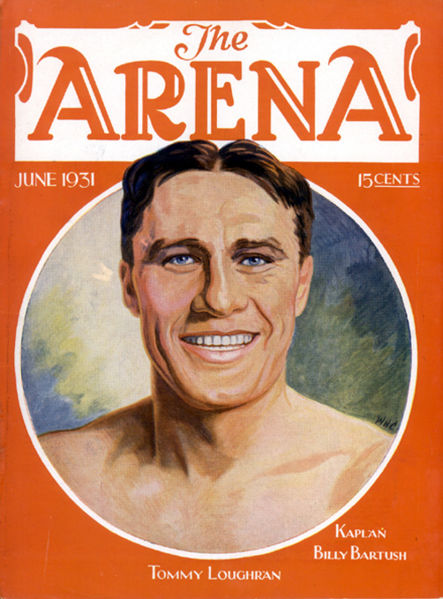
Victoria aut Mors - Tommy Loughran


There's Philadelphia, the historic "City of Brotherly Love," and then there's boxing's Philadelphia - the city with an unquestionable penchant for producing the type of fighters that laugh off blood and smirk at guts. 


But the industrial apathy of early 20th century Pennsylvania gifted the boxing world with one of the original "Philly fighters," Tommy Loughran. 


He doesn't quite fit the schema of the brawling boxer we're used to hearing about; Tommy was actually much more defensive-minded stylist than say Matt Saad Muhammad or Joe Frazier, to put it lightly.


However, Loughran was a legitimate professor in the ring. The issue was simply that it wasn't often thrilling, and he is regrettably shortchanged for it as time goes by. 


 Even in 1928, essentially Loughran's prime (or close to it), the Springfield Republican stated, "...for years Loughran was regarded as a colorless, uninteresting sort of fighter. He is a fine looking chap, of wonderful physique and handsome features, but he couldn't hit a lick on earth, and he was given to defensive tactics to a degree that was positively annoying." 


Monday, September 19, 2011

You Don't Tug on Floyd's Cape

Photo: AP/Eric Jamison


Home Box Office has carved a space in the world of outstanding production in a few different areas, and especially boxing. 


Aside from HBO Sports though, its original programming is consistently the type of stuff that wins Emmys. It's just accepted at this point. 


A few years back HBO aired a program called Carnivàle - an award-winning show about a traveling carnival and sideshow in the Dust Bowl Era. 


On the surface, Carnivàle was a grimy, realistic take on how your average degenerate survived in extremely tough times. The show touched on much broader, cryptic issues though, most of which unfortunately never got resolved, as the show was canceled after a second season for casting reasons. 


But in a particularly memorable episode of the first season, the sideshow exacts what it refers to as its own "carnival justice," forcing a potential murderer to play a twisted version of Russian Roulette when unable to rely on outsiders to uphold the law. 


There weren't many bearded ladies or reptile people in the MGM Grand on Saturday night (Cirque de Soleil notwithstanding), but Floyd Mayweather relished the role of villain as he doled out his own kind of justice over a foggy-headed Victor Ortiz, with a surreal finish nobody could have seen coming. 


Friday, September 16, 2011

Mayweather vs. Ortiz - Who Laughs Last?

Photo: Gene Blevins/Hogan Photos


The template for "big event" in today's sport has been etched and rehashed numerous times over the last few years, and the mega, ultra, stupendous, gigantic and supposedly captivating matchup between Floyd Mayweather Jr. and Victor Ortiz tomorrow does little to deviate from that formula. 


Leading to "fight week" this week, endless delectable details have been examined, reexamined and applied towards various predictions about the fight. 


We've been spared none of the quotes and dramas that have made spectacles of recent big fights - even what basically amounted to a televised excommunication of a family member on HBO's 24/7 series. 


Right or wrong, we'll watch. And we won't know whether it was right or wrong until we watch. 


Tuesday, September 13, 2011

Victoria aut Mors - Tony Zale


The words "dirty" and "crafty" are often interchangeable in this great sport. 


One might be less likely to decry the not-so-sweet portion of the sweet science if brought up, for example, in a town like Gary, Indiana - a town created from the flattened remnants of sand dunes for the specific purpose of building steel manufacturing plants. 


A few years before Anthony Florian Zaleski was born in 1913, a writer named William B. Hard made public the dangerous and poor working conditions in steel mills in nearby Chicago with an article entitled "Making Steel and Killing Men."


And making steel in a steel mill was basically the story of Tony Zale's childhood.  


When he was just 2-years old, his father was run over by a car and killed while bicycling to the drugstore, leaving his mother to raise a handful of kids alone. 


Like many children born into immigrant families in Gary's Central District, Tony worked the mills with his older brothers when he was old enough to. He would later say, "It seemed like I worked in the steel mills since I was weaned, breathing the burnt air, catching [with a bucket] the hot rivets that could burn a hole right through you if you missed."


Wednesday, September 7, 2011

HBO & Haymon's Fling Shooting Blanks


Business relationships are all about coming to a mutually beneficial understanding - the old quid pro quo, as it were. 


And the business of boxing is making gymnasts out of fighters - that is, having them bend every which way to get screwed by any means possible. 


A novel concept this is not. Boxers by nature are rarely the most intelligent (or even cunning) mind in the equation; when they are, they're superstars that are the exception, not the rule. Over the long haul, the non-combatants have reaped more consistent rewards than the guys lacing up the leather. 


But the advent of television altered the way money flows through the sport. 


Even over 100 years ago, Jack Johnson and Stan Ketchel negotiated their way to a 40% cut of television/motion picture money that flowed in as a result of their infamous cakewalk gone awry. 


Much more recently, in the 1973, a new player rolled up to boxing's doorstep: Home Box Office.